May it be as sweet as pumpkin pie!
|
|
|
|

You’ll find our blog to be a wealth of information, covering everything from local market statistics and home values to community happenings. That’s because we care about the community and want to help you find your place in it. Please reach out if you have any questions at all. We’d love to talk with you!
May it be as sweet as pumpkin pie!
|
|
|
|
|



HIGHLIGHTS
HIGHLIGHTS

As escalation clauses become more popular during this hot seller’s market, buyers should consider the pros and cons of using them – as well as the broader legal context of their offer.
ORLANDO, Fla. – During this white-hot seller’s market, many conversations on Florida Realtors® Legal Hotline involve multiple offer scenarios. Buyers are desperately seeking ways to try and make their offer stand out. One method that has rocketed in popularity is using an escalation clause.
There are many variations of these clauses, but the one thing they have in common is that a buyer is willing to increase the purchase price above the amount in the initial offer. A simple version of an escalation clause may read something like this: “Buyer agrees to pay $____________ more than the next highest offer, not to exceed a final purchase price of $___________.”
This is the core concept, at least. Most clauses will also include some combination of the following components, although this is by no means an exhaustive list. The clause can get increasingly more complex the more a buyer adds to the clause.
The positive side of escalation clauses is that they may make a buyer’s offer stand out. It also invites a seller to take an easy path to finalize negotiation.
Most of the confusion we hear about these clauses on Florida Realtors Legal Hotline centers around the fact that the buyer’s offer is just that – an offer. A seller who receives an offer can accept, reject, counter, or even ignore an offer.
For example, can the seller send a brief message that instructs the buyer to submit a new, “highest and best” offer, with a fixed purchase price by a deadline? Yes – the seller is welcome to reject the buyer’s offer.
What if the seller removes the escalation clause and counters the buyer’s offer right at buyer’s maximum price cap with no information about any other offers? Can the seller do that? Yes – the seller is welcome to counter buyer’s offer.
Can the seller go with a different buyer’s offer (even a lower-priced one) and never inform the buyer with the escalation clause? Yes – the seller is welcome to ignore the buyer’s offer.
As you can see, the crux of most buyer frustrations centers on the concept that the seller isn’t bound to follow the rules in the escalation clause unless the seller accepts the offer.
Please note that there are additional angles to this issue – this brief article is simply designed to give an overview of the escalation clause itself. For example, although this article mentions a seller’s right to ignore an offer, a listing Realtor must comply with this Standard of Practice from NAR’s Code of Ethics:
REALTORS®, in response to inquiries from buyers or cooperating brokers shall, with the sellers’ approval, disclose the existence of offers on the property. Where disclosure is authorized, REALTORS® shall also disclose, if asked, whether offers were obtained by the listing licensee, another licensee in the listing firm, or by a cooperating broker.
Joel Maxson is Associate General Counsel for Florida Realtors
© 2021 Florida Realtors®
By Elizabeth Renter, April 26, 2021
SAN FRANCISCO – It’s a good time to be a home seller – homes are selling fast and for a premium – but that doesn’t mean you can jump into the market ill-prepared. Knowing what to expect can position you to make the most of this seller’s market.
Roughly 1 in 6 (17%) homeowners plan on selling their home in the next 18 months, according to a new NerdWallet survey conducted online by The Harris Poll among 2,127 homeowners. Those listings will be a welcome sight to buyers currently competing for a limited number of homes commanding top dollar.
The March survey found that this current market is playing a role in many of these home sellers’ motivations. In fact, 45% of those planning to sell in the next 18 months say recent changes to the housing market, including higher asking prices and lower inventory, have spurred them to sell earlier than initially planned. If you’re among the homeowners preparing to be on the favored side of this strong seller’s market, here’s what you need to know.
In addition to cleaning your house for showings, preparing to sell your home often means doing minor (or major) repairs and upgrades. But homebuyers are stalking real estate listings and jumping on those that even get close to checking all the boxes, so sellers could likely save some money by limiting or forgoing expensive projects altogether.
More than 4 in 5 (81%) homeowners planning to sell in the next 18 months say they plan to spend money on major repairs or renovations to make their home more appealing to potential buyers prior to selling, typically planning to spend $2,000. But 17% of those planning to sell in the next 18 months who will spend money on repairs and renovations prior to selling say they’ll spend $15,000 or more.
“You really can get away without doing renovations and minor repairs,” says Holden Lewis, NerdWallet mortgages expert. “Unless the house has a major problem like a leaky roof, you’re probably better off selling as-is. Make it a priority to declutter and depersonalize the home so it’s easy for buyers to imagine themselves living there. The buyers can fix it up and renovate it on their own dime and schedule.”
If you list your home in this market, there’s little question of the outcome. Barring any significant defaults or dramatic overpricing, you’ll sell your home. It will happen quickly, and you could receive multiple offers over listing price.
Nearly half (45%) of homeowners planning to sell in the next 18 months say recent changes to the housing market have spurred them to sell earlier than initially planned, according to the survey. Single-family homes are in high demand, so selling now means you’ll sell faster and for a higher price than you would under other conditions.
Existing homes are only on the market for an average of 20 days, according to the most recent data from the National Association of Realtors – that’s listed and under contract in less than three weeks. So be prepared to sell the moment you hang that “For Sale” sign. It’s ideal to have your next home already lined up, but that may be easier said than done.
The very things that make it a good time to sell make it a tough time to buy a house. Just 10% of those planning to sell in the next 18 months say one of their primary motivations for selling is that they no longer want to be a homeowner, according to the survey. For the rest of these sellers, entering the crowded pool of homebuyers will present challenges.
Whether it’s the location – such as moving closer to family, outside of the city or for a new job – or the home features, every item on your list of must-haves will make finding your next home a greater challenge.
Given the likely ease with which you’ll sell and the difficulty you might have finding a replacement home, it may make sense to be under contract on a purchase when or soon after your home hits the market.
“The trickiest part of navigating today’s market is finding a home to replace the one you’re selling,” Lewis says. “You can make the buyer’s purchase contingent on your finding suitable housing. In other words, you can make your buyer wait. Normally, buyers are reluctant to accept that condition, but we’re in a seller’s market and sellers make the rules.”
This article originally appeared on the personal finance website NerdWallet. Elizabeth Renter is a writer at NerdWallet. Survey methodology available on NerdWallet.
Copyright © 2021 The Associated Press. All rights reserved. This material may not be published, broadcast, rewritten or redistributed without permission.
|
|
|
|
|
Florida Realtors economist: Why should I list now? Show them why graphically based on 1) different home needs, 2) low mortgage rates and 3) equity potential. In 2020, over one-third of Fla. single-family home sellers cashed out and received their list price or more.
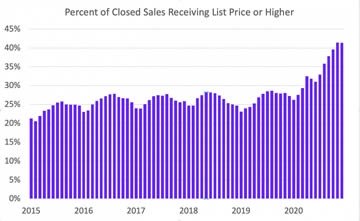
ORLANDO, Fla. – Realtors® can help show sellers the money (and get their listing)! In 2020, one in three (34%) single-family home sellers received their original list price or higher. From 2015-2019, this was true for about one in four sellers (26%).
By month, a more striking trend emerges. In November and December last year, over 40% of sellers received their list price or higher.
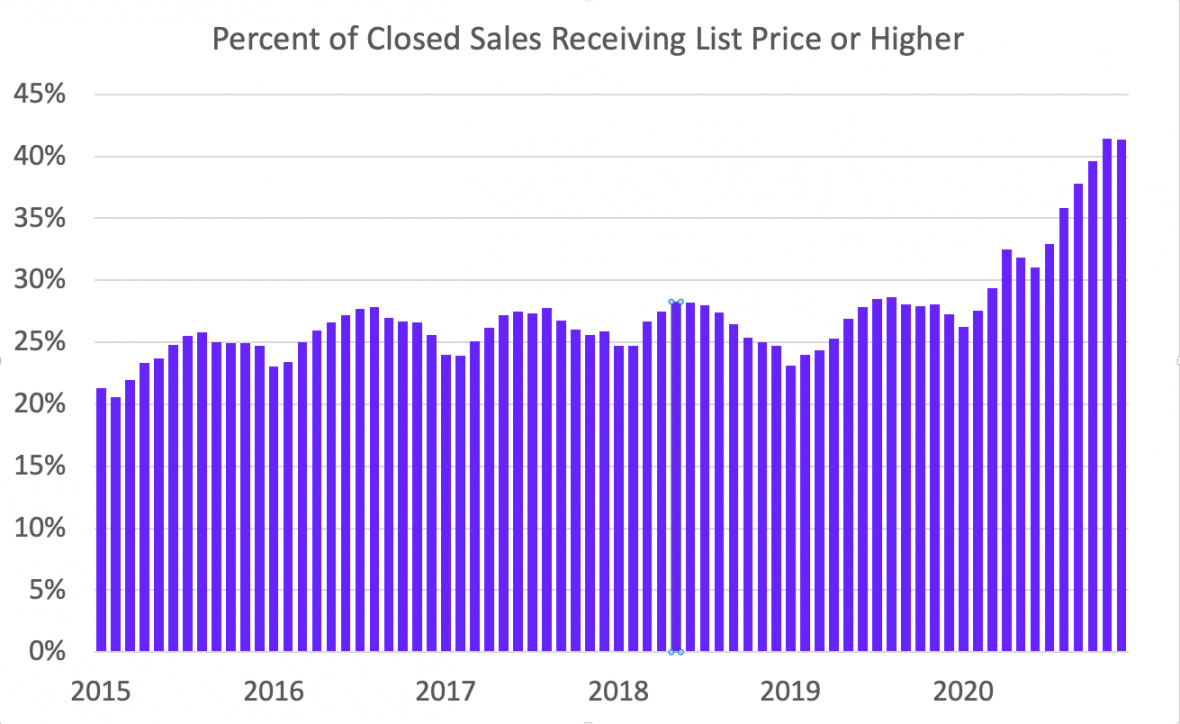
As buyers compete for a limited supply of homes, the pendulum swings farther in favor of sellers. The Florida single-family home market ended 2020 with 1.8 months’ supply of inventory (MSI), meaning the amount of time it would take to deplete inventory at the current sales pace if no additional homes enter the market.
As a gauge, analysts tend to use 5-6 months as the benchmark for a balanced market, so it’s clear sellers currently have the upper hand. Many sellers did list their properties in 2020, as new listings for single-family homes were down only 3% compared to 2019. But this was not enough to meet the strong demand once lockdowns lifted.
Demand varied by price tier but rose across the board. Nearly 50% of homes in the $150,000-$300,000 range closed with offers equal or greater than their list amount at the end of 2020.
While they may not be broadly accessible, luxury properties benefited from increased demand as well. In the past, homes listed for $1 million or more were less likely to receive an offer meeting or exceeding the list price – one in 10. In December, the number approached one in five (19%).
Although there are no price guarantees, sellers should be confident that they can cash-in on their equity. Today, homeowners – even those underwater in the late aughts – have gained equity from rising home prices. Many sellers get what they ask, but more aren’t jumping into the market because selling is a double-edged sword. If they sell their home, will they have one to buy?
New home construction lags demand; and worse, building has not kept pace for the past decade. The tenure of homeowners persists at historic highs. Florida sellers report a median of 11 years in their residence, according to the latest Profile of Home Buyers and Sellers in Florida report.
There are limited options for both new and existing homes. As buyers, sellers will face obstacles, but there are factors in addition to equity for them to list now.
Interest rates hover at historic lows and sometimes hit new records. Looking ahead, the consensus among economists is slightly rising rates in 2021 to around 3% for a 30-year fixed-rate mortgage. Owners can achieve mortgage savings by refinancing. Yet for some, selling and purchasing a different home may be the wiser option.
The pandemic caused economic uncertainty yet spawned motivations to move. “Home” must function like a living space as it always has, as well as an office, school, recreation center and more. Progress continues with health guidelines and vaccinations, but remote work and other changes are likely here to stay. Owners who believe their residence falls short of their needs may consider upgrading.
Realtors can help bridge the gap. Reach out to past clients who purchased at higher rates but may have different requirements as “home” evolved in 2020. More existing home sellers can ease some of the inventory crunch, or at least contribute to the churn in the market. You can instill confidence in both sides of the transaction to move sellers off the sidelines.
Erica Plemmons is an economist and Director of Housing Statistics
© 2021 Florida Realtors®
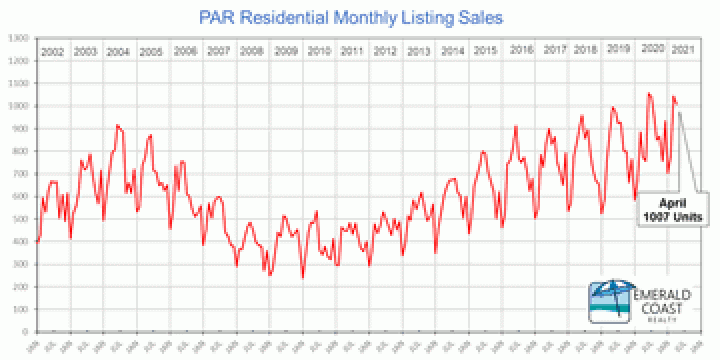
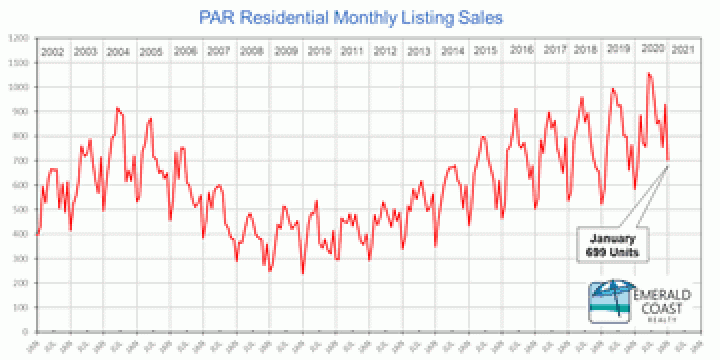
The monthly January PAR stats.
HIGHLIGHTS
.
Have a great week!
Emerald Coast Realty
850.485.3575
Mortgage Rates Move Lower, Down to 2.73%
The average 30-year, fixed-rate mortgage dropped from last week’s 2.77%. A Freddie Mac economist attributes it to a new administration and COVID-19 “malaise.”
MCLEAN, Va. – Freddie Mac’s mortgage survey this week found a slight drop in the 30-year, fixed-rate mortgage (FRM). It averaged 2.73% compared to last week’s 2.77%.
“As the market reacts to a new administration in Washington and COVID-19 driven economic malaise, mortgage rates continued to decrease this week, just slightly,” says Sam Khater, Freddie Mac’s chief economist. “Even as house prices increase at the fastest rate we’ve seen in years, competition to buy is strong, given the low inventory that exists across the country.”
Khater considers the low inventory of for-sale homes “an ongoing issue for the foreseeable future.”
The 2.73% average fixed-rate mortgage had an average 0.7 points. A year ago, the 30-year FRM averaged 3.51%.
The 15-year fixed-rate mortgage also fell marginally this week, average 2.20% with an average 0.7 points. One year ago, the 15-year FRM averaged 3%.
However, adjustable-rate mortgages remained stable this week. The 5-year Treasury-indexed hybrid adjustable-rate mortgage (ARM) averaged 2.80% with an average 0.3 point – the same rate as last week. One year ago, the 5-year ARM averaged 3.24%.
© 2021 Florida Realtors®